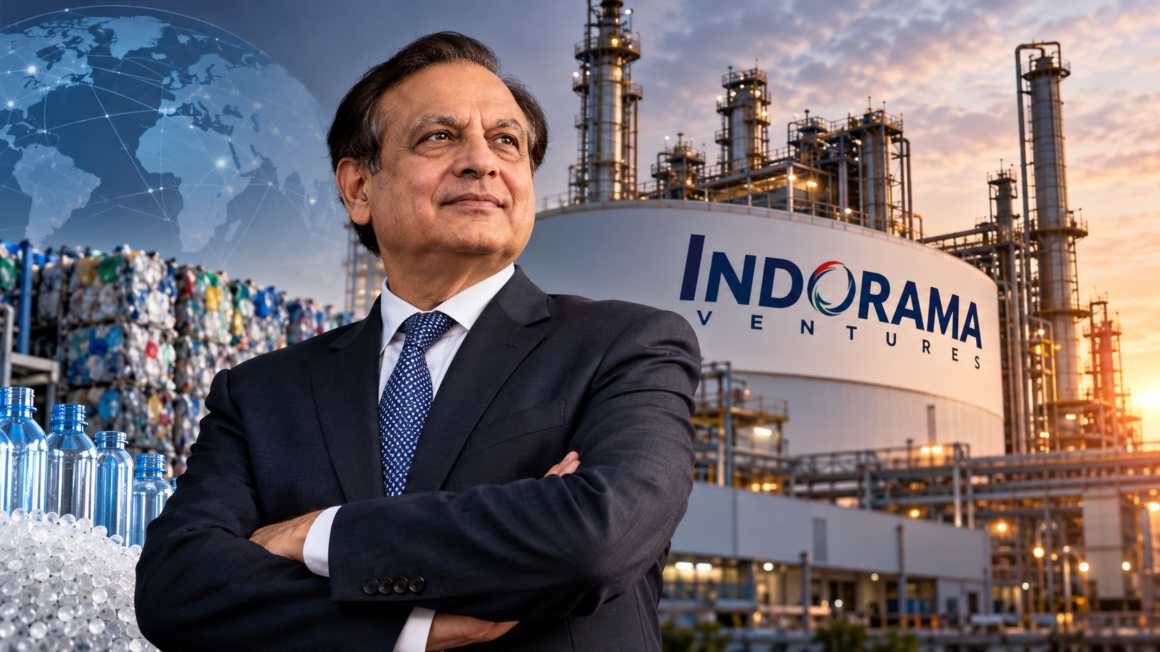
After three decades of building a global plastics and chemicals empire through relentless expansion, billionaire founder Aloke Lohia is attempting something arguably harder: simplifying it. Indorama Ventures’ improving 2026 numbers suggest the strategy is beginning to work—but a debt-heavy balance sheet, Chinese overcapacity and volatile chemical markets mean the founder’s most consequential transformation is still unfinished.
For much of Aloke Lohia’s career, growth meant buying.
The India-born entrepreneur turned a relatively small Thailand-based industrial business into Indorama Ventures, one of the world’s biggest polyester and PET producers, through an acquisition machine that crossed continents and product categories. By 2024, Reuters reported that Indorama Ventures had completed roughly 50 acquisitions over two decades with a combined enterprise value of $10.9 billion.
That strategy built scale few competitors could replicate.
It also built complexity.
Today, the transformation underway at Bangkok-listed Indorama Ventures is almost the inverse of the one that created it. Plants are being closed or rationalized. Capital expenditure is being scrutinized. Inventory is being squeezed. Non-core assets are being reviewed. Debt reduction has moved ahead of acquisition-led expansion. And businesses that once sat inside one sprawling industrial organization are increasingly being asked to justify their capital on their own merits.
For Lohia, the dealmaker is being forced to become the disciplinarian.
The early evidence in 2026 is encouraging.
For the first half of the year, Indorama Ventures reported revenue of THB245.3 billion, up 4% year-on-year, while EBITDA surged 61% to THB29.7 billion. Operating cash flow after maintenance capital expenditure climbed 78% to THB25.9 billion. Inventory turnover improved to 5.0 times from 4.7 times at the end of 2025.
Most importantly, the balance sheet started moving in the direction investors had been waiting for. Net debt fell by THB9.6 billion, from about THB236 billion at the end of 2025 to THB226.4 billion at June 2026, while net debt-to-EBITDA dropped from 7.6 times to 5.3 times.
That is meaningful progress.
It is not yet victory.
From Empire Building to IVL 2.0
Indorama’s current predicament cannot be understood without understanding how extraordinary its expansion was.
Lohia, born in Calcutta in 1958, built his career in Thailand after starting out in the family’s industrial businesses. He later established a wool operation before entering PET production in the mid-1990s, eventually turning Indorama Ventures into a global chemicals platform.
The model was well suited to an era of globalization: acquire assets, integrate production chains, build scale in PET and polyester, and use the resulting geographic footprint to serve multinational customers locally.
By 2025, Indorama Ventures operated 135 sites in 31 countries. Its businesses ranged from Combined PET and fibers to specialty chemicals under Indovinya and packaging under Indovida. Revenue for the year was THB447.2 billion.
But the economic environment around that empire changed.
Chinese petrochemical capacity expanded even as growth in demand became less dependable. European producers faced high structural costs. Interest rates rose. Energy and crude-oil markets became more volatile. Global manufacturing chains became less predictable. What once looked like valuable capacity increasingly risked becoming expensive capacity.
The consequences showed up starkly in Indorama’s accounts.
Revenue fell from THB541.6 billion in 2024 to THB447.2 billion in 2025. Reported EBITDA dropped about 35% to roughly THB32 billion, while the company recorded a net loss attributable to shareholders of approximately THB7.35 billion. That followed an even larger THB19.3 billion loss in 2024.
Production volume also fell 9% in 2025 to 12.8 million tonnes.
It was against this backdrop that Lohia began remaking the group under a program called IVL 2.0.
Announced in 2024, the strategy represented a fundamental break with the old acquisition-first playbook. Management proposed optimizing the manufacturing footprint, cutting costs, improving cash generation, selling assets and reducing debt. Project Olympus 2.0, its efficiency program, was initially expected to generate as much as $450 million in run-rate benefits by 2026.
Reuters described the strategic shift more bluntly: Indorama intended to move away from debt-funded acquisitions, dispose of non-core assets and eliminate high-cost capacity.
For a founder whose reputation had been built on expanding an industrial footprint, it amounted to a change in corporate instinct.
Cutting Capacity to Save the Company
Turnarounds become credible when management starts taking decisions it previously avoided.
At Indorama, that has meant accepting that some plants are worth more closed than operating.
The company rationalized sites across Portugal, the Netherlands, Australia and Canada. By mid-2025, those actions were producing about $116 million of fixed-cost savings.
The restructuring has not been painless.
Management said in late 2025 that approximately 2.7 million tonnes of capacity had been rationalized since 2023, accompanied by roughly $1.2 billion of impairments.
In Rotterdam, Indorama reviewed and restructured PTA and PET production. In Montréal, it moved to discontinue a PTA operation. Australian surfactant assets were also rationalized.
These decisions matter because the chemicals industry often punishes companies for continuing to operate marginal capacity simply to maintain volume.
Indorama appears increasingly willing to sacrifice tonnes for returns.
That distinction is central to Lohia’s second act.
The objective is no longer simply to be bigger. It is to make the remaining industrial system generate enough cash to support itself, service its debt and earn an acceptable return on the billions invested in it.
Cash, Not Capacity, Is the New Currency
One of the more revealing elements of the turnaround is the language management now uses.
Cash conversion, working capital, inventory discipline, return on capital and absolute net debt have moved to the centre of the corporate story.
In the first half of 2026, operating cash flow after maintenance capex reached THB25.9 billion, equivalent to roughly 87% of EBITDA. Indorama reduced net debt while funding interest costs, dividends and growth investment.
Inventory management is also becoming a financial tool rather than merely an operating metric. Inventory turnover rose to 5.0 times in the second quarter from 4.7 at the end of 2025, reflecting tighter sales-and-operations planning and working-capital management.
Indorama has simultaneously been working on the liability side of the balance sheet.
In 2025, specialty-chemicals subsidiary Indovinya raised $1.5 billion through a syndicated term loan to refinance debt and strengthen its capital structure. The company said the refinancing extended maturities and improved funding terms.
Together, those moves suggest IVL 2.0 is evolving from restructuring rhetoric into measurable financial mechanics.
But there is an important piece of historical context.
When Indorama unveiled its strategic pivot in March 2024, the company talked about reducing net debt by $2.5 billion to around $4.3 billion during 2026 and bringing debt-to-EBITDA below three times.
By its 2026 Capital Markets Day, the sub-three-times leverage target had shifted to 2028.
That extension is a reminder of how severe the downturn became—and why the turnaround should be judged by execution rather than targets alone.
The 2026 Inflection Point
The second quarter of 2026 provided the strongest evidence yet that operating conditions and management action were finally moving in the same direction.
Indorama reported quarterly net income of THB5.96 billion, compared with a THB521 million loss in the second quarter of 2025.
The improvement was broad-based: all four major business segments posted year-on-year EBITDA gains during the quarter. Combined PET, the core of Indorama’s industrial franchise, benefited substantially from improved market conditions.
There is, however, a critical distinction.
Not all of the improvement came from restructuring.
Indorama explicitly attributed its first-half performance to a combination of management actions and favorable market conditions. Benchmark spreads in PET strengthened sharply during the period, helping lift profitability.
That means investors still need to discover how much earnings power remains when those spreads normalize.
The company itself has cautioned that second-half 2026 earnings are expected to moderate.
A durable turnaround therefore cannot depend on a commodity upswing. It must work through the cycle.
The Moat Lohia Still Has
Indorama does possess advantages that make a recovery plausible.
One is geography.
Approximately half of company revenue is generated in the Americas, where access to relatively advantaged shale-based feedstocks supports around 60% of contribution margin, according to the company.
That gives parts of Indorama’s North American system a structural advantage over European and Asian producers dependent on higher-cost naphtha economics.
Another advantage is scale.
In PET, scale creates purchasing power, customer reach, feedstock integration and logistics flexibility. A global footprint means production can, in some cases, be shifted or sourced from alternative facilities when individual plants become uneconomic.
The question is whether that scale can now be made less capital-hungry.
This is why portfolio reorganization is as important as plant closures.
India Becomes Part of the Growth Equation
Even while shrinking parts of its legacy footprint, Lohia is not abandoning growth.
He is changing its form.
India has become one of the clearest examples.
In 2025, Indorama acquired a 24.9% stake in packaging company EPL from Blackstone, deepening its exposure to a fast-growing consumer market.
Then, in March 2026, Indorama-backed Indovida India agreed to merge with EPL, creating a consumer-packaging platform valued at roughly $2 billion. The transaction is structured to give Indorama Ventures approximately 51.8% ownership and co-promoter status in the combined company. India’s Competition Commission approved the merger in May.
The strategic logic is different from the old acquisition playbook.
Instead of simply adding another wholly owned industrial asset to the parent balance sheet, Indorama is combining assets, using partnerships and public-market structures, and concentrating on higher-growth packaging markets.
That potentially allows the company to participate in growth without recreating the leverage problem it is currently trying to solve.
It also reveals where Lohia thinks future value may reside: less in commodity capacity for its own sake, and more in differentiated businesses serving consumer, specialty-chemical and emerging-market demand.
A Founder Reinvents His Own Formula
This may ultimately be the most significant dimension of the Indorama story.
Founders often become prisoners of the strategy that made them successful.
An entrepreneur who wins through acquisitions tends to keep acquiring. A manufacturer who wins through capacity tends to keep building capacity. The organizational habits formed during expansion can persist long after the economics that justified them have disappeared.
Lohia appears to have recognized that Indorama’s next chapter requires a different formula from its first.
At the 2026 Capital Markets Day, management laid out five priorities: structural cost leadership, commercial and manufacturing excellence, portfolio reorganization, inventory optimization, and rigorous cash and capital management.
The targets are ambitious.
By 2028, Indorama aims to generate approximately THB64 billion of EBITDA, deliver a 12% EBITDA margin, reduce net debt by THB68 billion and lift return on capital toward 11%, while pushing net debt-to-EBITDA below three times.
To get there, Lohia no longer needs simply to find the next deal.
He needs to make the existing empire work harder.
The Risk Behind the Recovery
The balance sheet remains the clearest vulnerability.
A fall in net debt-to-EBITDA from 7.6 to 5.3 times in six months is substantial, but 5.3 times is still high for a cyclical industrial company. At June 2026, absolute net debt remained about THB226.4 billion.
China remains another uncertainty. Continued capacity additions can suppress margins even when demand improves. European assets face structural energy and operating-cost disadvantages. Crude oil and currencies can move earnings and working capital in ways management cannot fully control.
And there is an execution question.
Closing a plant can remove losses; creating structurally superior returns across a sprawling multinational portfolio is harder.
The next stage of the Indorama turnaround will therefore be measured less by quarterly EBITDA spikes and more by three numbers: absolute net debt, sustainable free cash flow and return on capital.
If those improve while benchmark margins normalize, Lohia will have demonstrated that IVL 2.0 is more than a cyclical recovery.
The Second Act
At 67, Lohia remains both founder and Group CEO of a company whose scale would have been difficult to imagine when he began manufacturing in Thailand decades ago.
Forbes estimated his personal fortune at about $1.7 billion earlier in 2026, although billionaire wealth tied to public equities naturally fluctuates with share prices.
The more interesting measure of his legacy, however, may no longer be personal wealth or how many plants Indorama owns.
It may be whether he can redesign the industrial empire he spent three decades assembling.
The first transformation of Indorama Ventures was about turning a local manufacturer into a global chemicals powerhouse.
The second is about proving that global scale can produce disciplined returns.
The first half of 2026 suggests the script is beginning to change: earnings have recovered, cash generation is stronger, inventory is tighter and debt is falling. Yet management’s own revised timetable acknowledges that the balance-sheet repair will take longer than initially anticipated.
So the Indorama story is not yet a completed turnaround.
It is something more interesting—a billionaire founder trying to dismantle some of the habits that made him successful in order to preserve what those habits built.
For founders everywhere, that may be the larger lesson.
Building an empire requires conviction.
Knowing when to rebuild it requires something rarer: the willingness to challenge your own winning formula.